
Parent-friendly guide with expert strategies you can start today
Speech and language development during the toddler years lays the foundation for communication, social skills, and early learning. The ages between 12 months and 4 years are especially important—this is when toddlers begin combining words, expressing their needs, and building speech clarity. Many parents worry when their child seems “late to talk,” but the good news is this: you can do a lot at home to support speech development, even without special training.
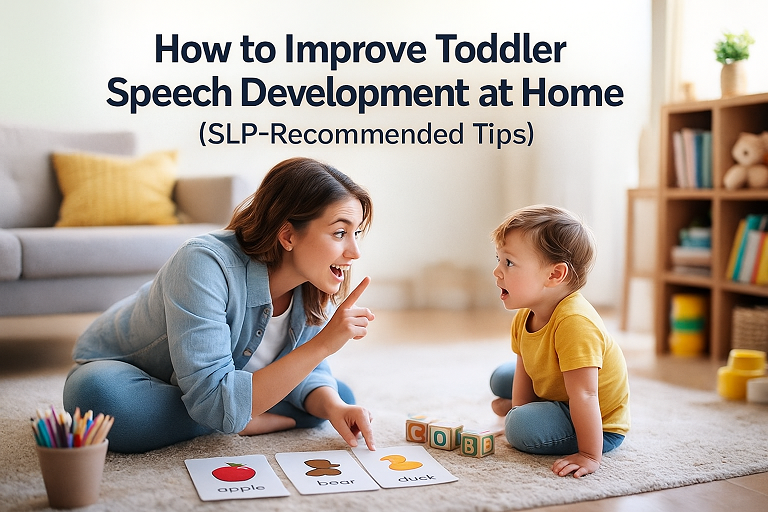
This comprehensive, SLP-inspired guide will show you how to encourage speech at home using simple, evidence-based techniques, natural routines, sensory-motor support, and play-based learning. It is written for parents, caregivers, and early interventionists who want practical steps that make a real difference.
Why Supporting Speech Early Matters
Toddlers learn language by hearing, imitating, experiencing, and interacting. When parents take an active role in communication, children often:
- Speak earlier
- Use more vocabulary
- Develop clearer articulation
- Build stronger social-emotional skills
- Gain confidence in expressing themselves
- Develop better comprehension and listening skills
The window for rapid neurological development is strong from ages 0–3, and continues powerfully through age 5. Daily parent-child interaction plays a central role in shaping how well toddlers learn to understand and produce language.
Signs Your Toddler May Need More Speech Support
Not all toddlers develop at the same pace, but early support is always beneficial. Talk to an SLP if you notice:
- Minimal eye contact
- Not responding to their name consistently
- Few or no words by 18 months
- No word combinations by age 2
- Difficulty imitating sounds
- Very unclear speech after age 3
- Limited gestures (pointing, waving, reaching)
This guide is helpful whether your toddler is delayed, on track, or advanced—because speech-supportive environments benefit every child.
⭐ SLP-Recommended Home Strategies to Improve Toddler Speech Development
Below are the most effective, research-backed tips you can use at home starting today. They require no special tools, but certain oral-motor or sensory tools can support children who benefit from additional tactile feedback.
1. Use the “Serve and Return” Communication Method
This is a powerful technique used in speech therapy and early intervention.
How to do it:
- Your toddler looks at something or makes a sound → serve
- You respond with words, sound imitation, or an expression → return
Example:
Toddler: “Ball!”
You: “Yes! Red ball! The ball is bouncing!”
This method improves:
- Vocabulary
- Joint attention
- Social communication
- Speech imitation
Even if your child is nonverbal, they may serve through gestures, pointing, or eye gaze. Respond with enthusiasm and words.
2. Talk Through Your Daily Routines (Narration Method)
Narration—often called “self-talk” and “parallel talk”—helps toddlers learn language through natural context.
Self-Talk Example:
You describe what you are doing:
“Mommy is washing the apple. Mommy is cutting it. Slice, slice, slice.”
Parallel Talk Example:
You describe what your toddler is doing:
“You are pushing the car. The car is fast! Go, car!”
Narration teaches toddlers grammar, new vocabulary, and sentence structure without pressure.
3. Use Modeling Instead of Constant Questioning
Parents often ask too many questions:
❌ “What’s this?”
❌ “What color is this?”
❌ “Say truck!”
Instead, SLPs recommend modeling, which reduces pressure and increases natural learning.
Modeling Example:
Toddler: “Dog!”
You: “Yes! Big dog! Dog is walking. Happy dog.”
When modeling, expand their short phrases by one or two words.
4. Encourage Gestures and Signs to Boost Speech
Research shows that signs do NOT delay speech—they actually support it.
Toddlers who use gestures and basic signs often:
- Communicate sooner
- Reduce frustration tantrums
- Learn spoken words faster
Great starter signs: more, all done, milk, help, open, banana, eat, sleep
Combine signs with spoken words for best results.
5. Add Verbal Routines (Predictable Repetitions)
Toddlers thrive on predictable phrases. These are short “scripts” you repeat during everyday tasks.
Examples:
- “Ready… set… GO!”
- “Up… up… UP!”
- “1, 2, 3… jump!”
- “Open… shut… open… shut…”
When toddlers hear these over and over, they eventually attempt to fill in the missing word.
6. Read to Your Toddler Every Day (Even Just 5 Minutes)
Reading is one of the most powerful language-building activities.
Choose books with:
- Repetitive text
- Clear pictures
- Simple storylines
- Strong verbs and descriptive words
How to make reading interactive:
- Point to pictures and label them
- Pause to let your toddler fill in words
- Use gestures
- Act out actions (jump, run, sleep)
- Ask simple choice questions:
“Do you see the dog or the cat?”
7. Use Play-Based Speech Stimulation
SLPs heavily rely on play because it naturally builds language. Toddlers learn best when they’re having fun.
Top Play Activities for Speech Development
- Bubbles (pop, blow, up, more, help)
- Cars and trucks (go, stop, crash)
- Pretend kitchen (wash, cut, cook, eat)
- Animals (roar, moo, neigh, hop)
- Blocks (build, tall, fall)
- Dolls/figurines (sleep, jump, hug)
These activities create opportunities for labeling, verbs, sounds, and simple sentences.
8. Encourage Sound Imitation Before Word Imitation
If your toddler struggles to speak, start with sounds. They are easier to imitate than full words.
Great early sound targets:
- “mmm”
- “buh-buh-buh”
- “pah!”
- animal sounds: moo, baa, quack
- vehicle sounds: vroom, beep, choo-choo
These build oral control and pave the way for clearer words.
9. Use Oral-Motor and Sensory Tools (If Needed)
Some toddlers need additional sensory awareness, especially if they:
- Drool often
- Chew on objects
- Have low tone in the mouth
- Struggle with speech sound production
- Need more sensory feedback to activate lips and jaw
SLPs often recommend vibrating tools, chewy tools, or jaw-stabilizing tools for specific cases.
One commonly recommended option is the TalkTools line of sensory-motor tools. Many parents use items like the Jiggler oral motor tool by TalkTools to provide gentle vibration that increases jaw awareness, lip activation, and sensory engagement during play-based speech practice.
These tools should be used with guidance, but they can be extremely helpful for certain children.
10. Build Speech Opportunities (But Don’t Over-Prompt)
Instead of giving everything immediately, create natural situations where your toddler needs to communicate.
Example strategies:
- Give only a little of something (like 1 strawberry) → child says “more”
- Keep toys inside containers → child says “open” or “help”
- Put preferred items out of reach but visible
- Pause during familiar songs to let them fill in the words
These “communication temptations” encourage expression in natural ways.
11. Slow Your Speech and Use Clear Sounds
Toddlers learn articulation by hearing correct sound patterns.
Speak in:
- Short sentences
- Clear consonant sounds
- Slightly slower pacing
- Emphasized key words
- Natural intonation
Avoid baby talk—use real words with correct pronunciation.
12. Label Emotions to Build Social Language
Speech isn’t only about vocabulary—it’s also about expressing feelings.
Use emotional labels during daily interactions:
- “You’re happy!”
- “You look frustrated.”
- “You’re excited!”
- “Oh no, you’re sad.”
This improves communication, regulation, and connection.
13. Encourage Pretend Play for Stronger Language Skills
Pretend play boosts imagination, social communication, and early storytelling.
Great pretend-play themes:
- Doctor checkup
- Baby doll caregiving
- Cooking and shopping
- Farm animals
- Construction site
- Tea party
During pretend play, narrate actions, ask simple questions, and introduce new verbs.
14. Reduce Passive Screen Time
Excessive screen use can slow speech development because toddlers need human interaction for language learning.
If screens are used:
- Choose interactive, slow-paced content
- Watch WITH your toddler
- Talk about what’s happening
- Connect the content to real life
15. Celebrate Every Attempt (Even Incomplete Words)
Reinforcement matters. When your toddler attempts a sound or word, respond with excitement—even if it’s not perfect.
Example:
Toddler: “Ca!” (meaning “car”)
You: “Yes! Car! The car goes vroom!”
Encourage progress, not perfection.
⭐ Home Speech Activities You Can Start This Week
Here are simple, SLP-approved activities you can use daily.
Activity 1: The “Fill-in-the-Blank” Game
Use songs, books, or routines.
Parent: “Twinkle, twinkle… little ___?”
Toddler: “Star!”
Activity 2: Sound Play With Bubbles
Say: “Pop! Pop! Big pop!”
Encourage your toddler to imitate the sound before saying the full word.
Activity 3: Snack Time Language Boost
During meals, label:
- textures (soft, crunchy)
- actions (bite, chew, drink)
- requests (more, all done, help)
Use simple, repetitive words.
Activity 4: Pretend Phone Conversations
Toddlers love pretending to talk on a phone.
You can model:
“Hello… how are you? I’m fine!”
It increases imitation and turn-taking.
Activity 5: Oral-Motor Playtime
If your toddler enjoys sensory feedback, add tools during play.
For example, use the TalkTools Jiggler tool for sensory oral play while practicing lip sounds like buh, puh, and mmm.
Recommended Daily Speech Routine (10–20 minutes)
Here’s a simple structure you can follow:
Morning (5 minutes)
- Narrate dressing routine
- Emphasize simple verbs (put on, zip, pull)
Afternoon (5–10 minutes)
- Read 1–2 short books
- Point and label items
- Use sound imitation
Evening (5 minutes)
- Sing a verbal routine song
- Practice gestures or signs
- Model emotion words
Consistency matters more than length. A few minutes every day is very effective.
What to Do If Your Toddler Still Isn’t Talking Much
If you have concerns, early intervention is key. Reach out to:
- A licensed Speech-Language Pathologist
- Your local early intervention program
- A developmental pediatrician (if needed)
Many toddlers simply need extra support, and with appropriate early guidance, most make significant progress.
Frequently Asked Questions About Toddler Speech Development
1. Does late talking always mean something is wrong?
No. Many toddlers are late bloomers, but monitoring progress is important.
2. Should I correct mispronunciation?
Gently model correct pronunciation but avoid saying “No, that’s wrong.”
3. Do apps help?
Interactive apps can supplement learning but should not replace parent-child interaction.
4. Are vibrating oral-motor tools safe?
Yes, when used with guidance. Tools like the TalkTools Jiggler device for oral-motor support are often recommended by therapists for sensory awareness and jaw activation.
Final Thoughts: You Are Your Toddler’s Best Speech Teacher
You don’t need professional training to support your toddler’s communication.
With simple daily interactions—talking, playing, reading, and modeling—you can dramatically improve language development.
Whether you’re supporting a late talker or helping an expressive toddler flourish, the strategies in this guide can transform how your child communicates.
Speak slowly. Play often. Model generously.
Your voice, presence, and connection are the most powerful speech tools your toddler will ever have.